



Third Time, Deeper Roots: Tanzania's EdTech Fellowship Welcomes Its Most Competitive Cohort Yet
The Mastercard Foundation EdTech Fellowship Cohort 3 Launches at Johari Rotana — 14 Ventures. 6 Regions. 9 Female-Led. And a Ministry Ready to Partner.
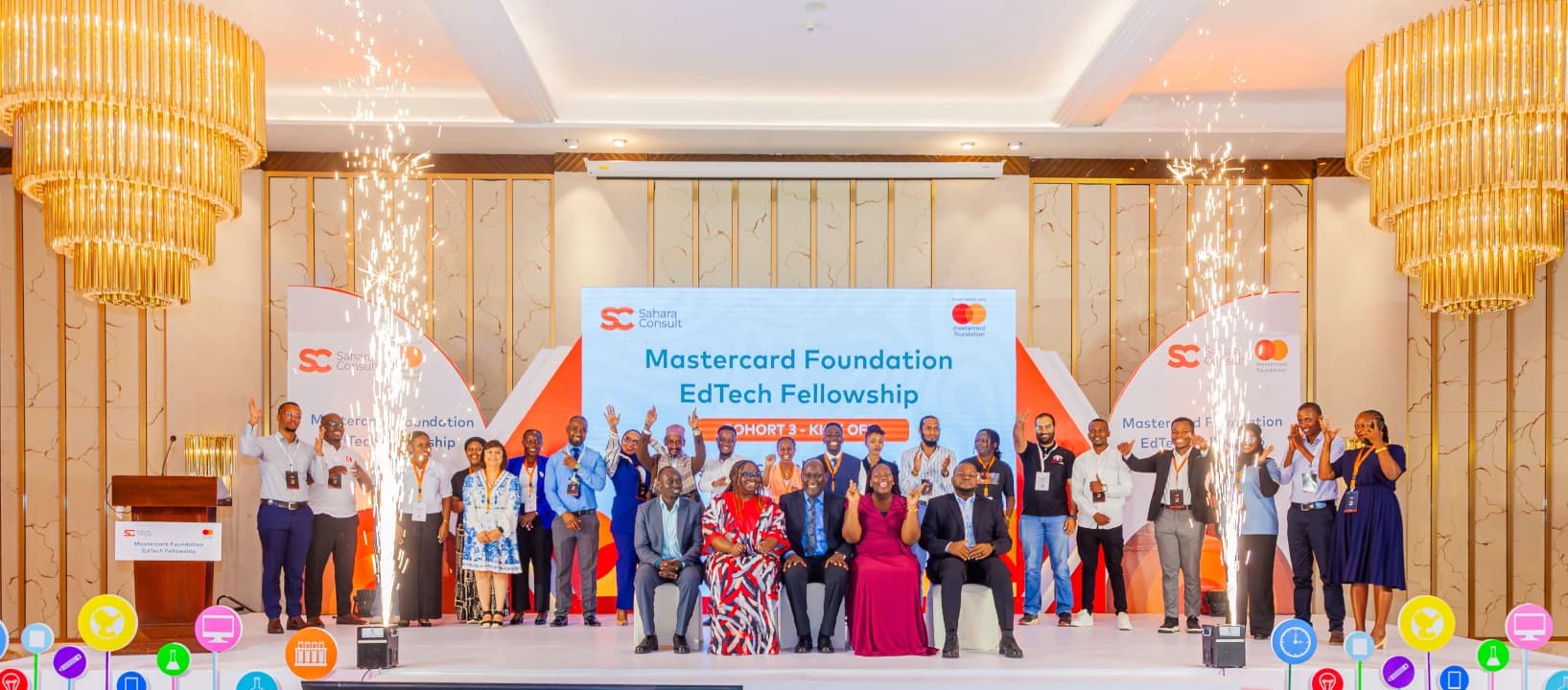
There is a particular energy in a room where the government, investors, educators, and founders occupy the same space - not as spectators of each other, but as stakeholders in the same mission. On the afternoon of 17 March 2026, that energy was palpable at Johari Rotana Hotel in Dar es Salaam, as 132 participants gathered to officially launch the third cohort of the Mastercard Foundation EdTech Fellowship.
This was not a ribbon-cutting. It was a reckoning — with what has already been built, with what still needs to change, and with the fourteen ventures now stepping forward to carry that work into the next chapter.
About the Programme
The Mastercard Foundation EdTech Fellowship is implemented by Sahara Consult in partnership with the Mastercard Foundation. The programme exists to accelerate EdTech companies that are improving access to quality education in Tanzania — providing them with structured technical support, business strengthening, regulatory engagement, strategic partnerships, and access to equity-free funding of up to USD 70,000 per fellow.
The programme's overarching goal is clear: to enhance access to education nationwide through technology, with a bold target of impacting over 200,000 learners annually, particularly in Tanzania's most vulnerable and underserved communities. Each cohort builds on the last — deepening ecosystem connections, expanding geographic reach, and raising the bar for what homegrown EdTech innovation can achieve.
Cohort 3 is the programme's most competitive intake to date: 14 fellows selected from 134 applications, through a rigorous three-phase expert-led selection process spanning desk review, deep evaluation, and live pitching.
A Message from the Mastercard Foundation
Following the CEO's opening remarks, the floor was passed online to Eliud Chemweno, Head of EdTech Ecosystems at the Centre for Innovative Teaching and Learning, Mastercard Foundation. Joining virtually, Eliud brought a message that grounded the Fellowship's ambitions within the Foundation's broader continental vision — and spoke directly to the fourteen founders who had just earned their place in Cohort 3.
Eliud's remarks set a tone of accountability alongside encouragement — reminding fellows that the Foundation's investment carries genuine expectations of growth, impact, and the courage to push through difficulty. It was a message heard clearly in a room that was already energised and ready.
A Selection Process Built on Rigour
The journey to this room began in November 2025, when Sahara Consult opened applications across Tanzania. The response was exceptional: 134 applications from innovators spanning every region of the country.
What followed was a three-phase selection process designed to be thorough, fair, and expert-led at every gate:
- Phase 1 - Desk Review: 134 applications assessed on innovation, impact potential, and relevance to Tanzania's education landscape. 73 advanced.
- Phase 2 - Deep Evaluation: Cross-sector specialists assessed scalability, market fit, team strength, and EdTech sector alignment. 40 advanced.
- Phase 3 - Live Pitching: The final 40 pitched before an expert panel applying both rigorous evaluation and a deliberate inclusion lens. 14 were selected.
At every phase, domain-specific experts, professionals who understood each vertical from the inside, made the calls. As Jumanne put it is not simply the best applicants. The right fit.
Cohort 3: A Snapshot
The 14 selected ventures span 6 regions — Dar es Salaam, Tanga, Arusha, Dodoma, Iringa, and Zanzibar. Nine are female-led. In the CEO's words: that is not a statistic. It is a statement.
Their solutions are as varied as the communities they serve: AI-powered personalised learning, SMS and offline platforms for low-connectivity environments, hardware-based tools, inclusive education for learners with disabilities, financial literacy platforms, and teacher professional development systems. Together, they represent what becomes possible when innovation meets purpose.
The Government Speaks, and It Means Business
The government delegation at the Kickoff was not merely ceremonial. Prof. Daniel Mushi, Deputy Permanent Secretary of the Ministry of Education, Science and Technology, delivered the keynote address, and was accompanied by Dr. Alcardo Alex Barakabitze, a senior representative from the Ministry's Department of Science, Technology and Innovation (DSTI), who formally welcomed Prof. Mushi to the stage and later anchored the Ministry's reflective engagement with the programme.
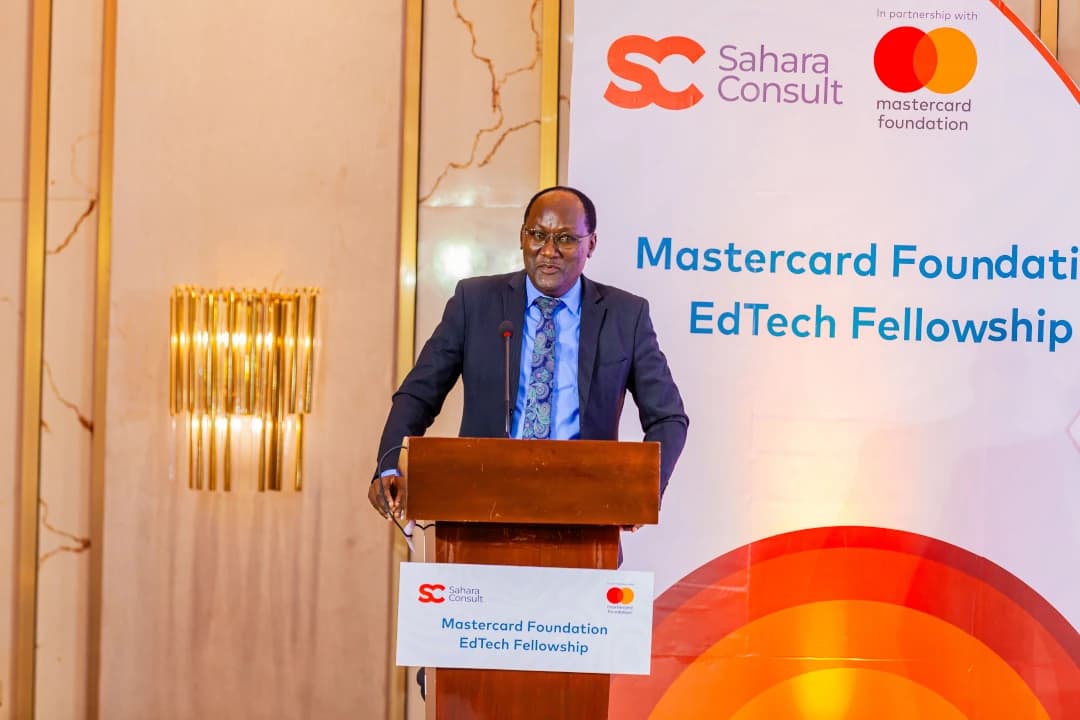
Prof. Mushi's keynote grounded the Fellowship firmly within Tanzania's national education policy architecture. He cited four frameworks that Cohort 3 fellows are expected to engage with: the Education and Training Policy (2023 Edition), the National Digital Education Strategy (2024/25-2029/30), the National AI Guidelines for Education, and the National Digital Education Guidelines for Schools and Teacher Colleges. His message was direct and substantive:
Prof. Mushi also reaffirmed the Ministry's commitment to the GIGA Project — the flagship initiative to connect every school in Tanzania to the internet — and called on the EdTech community to move beyond isolated pilots toward solutions aligned with the curriculum, adopted at scale, and trusted by schools and parents alike.
A Signal of Deeper Partnership: The Upcoming Multi-Ministry EdTech Workshop
Perhaps the most significant announcement of the day came not from the stage, but from the Ministry's reflective session - led by Dr. Alcardo Alex Barakabitze of the DSTI office. Beyond the keynote, Dr. Barakabitze conveyed a concrete and forward-looking signal of government intent: the Ministry of Education is preparing to host a dedicated, multi-day workshop specifically for EdTech startups and young innovators.
The workshop will be conducted in collaboration with the Ministry of Youth Development, TAMISEMI, the Ministry of Information and Communication Technology, and TCRA — a cross-government alignment that signals this is not a standalone initiative but part of a coordinated national push to embed EdTech into Tanzania's institutional fabric.

Critically, Sahara Consult has been invited to join the planning committee for the workshop — a recognition of the organisation's role as a trusted connector between Tanzania's innovation ecosystem and its policy environment. For Cohort 3 fellows in particular, this workshop represents a potential early-stage pathway into government procurement and adoption pipelines.
Learning from Those Who Came Before
One of the most distinctive elements of the Kickoff was a panel session featuring alumni from Cohorts 1 and 2 — founders who had walked the same journey the incoming fellows were about to begin. Representatives from Shule Yetu, FIQRA Academy, MITsKITS, and YanaCorp shared candid reflections on growth, monetisation challenges, and the role that mentorship and partnerships played in their acceleration journeys.
For Cohort 3 fellows, this was not just inspiration — it was intelligence. Real accounts of what worked, what stalled, and what no pitch deck can prepare you for.
Nancy Kiondo, in her closing remarks, captured what this alumni legacy means in numbers:
What Comes Next
The Kickoff set the stage for an intensive acceleration journey. Technical Assessments commence in late April 2026, establishing individual growth baselines for each venture. Fellows then move through expert-led masterclasses, due diligence site visits, mentorship matching, and investor readiness programming — culminating in a Demo Day that will bring Cohort 3 before the region's investment and policy community.
The evening closed not on a stage, but around a table. Sahara Consult hosted a shared Iftar in the spirit of Ramadhan, bringing together fellows, partners, alumni, and government representatives informally. As Nancy noted: “This is the moment where partnerships are truly formed — not on stage, but around the table.”
A Closing Thought
Cohort 3 has arrived. Fourteen ventures, from six regions, selected through one of the most rigorous processes in Tanzania's EdTech history. The acceleration journey ahead will be demanding. But the ecosystem gathering around them — of mentors, investors, alumni, and a Ministry actively seeking to adopt their solutions — has never been stronger. The work begins today. And Tanzania's EdTech story is only getting started.
The work begins today. And Tanzania's EdTech story is only getting started.