



The Device That Works When Everything Else Fails: How ChemCheemi Is Reframing EdTech for Underserved Learners
For years, education technology across Africa has largely followed the same assumption: meaningful digital learning depends on stable electricity, reliable internet, and access to expensive devices.
But for many schools and households, especially outside major urban centers, those conditions do not exist consistently enough to support how most edtech platforms are built.
That gap is where ChemCheemi is positioning itself.
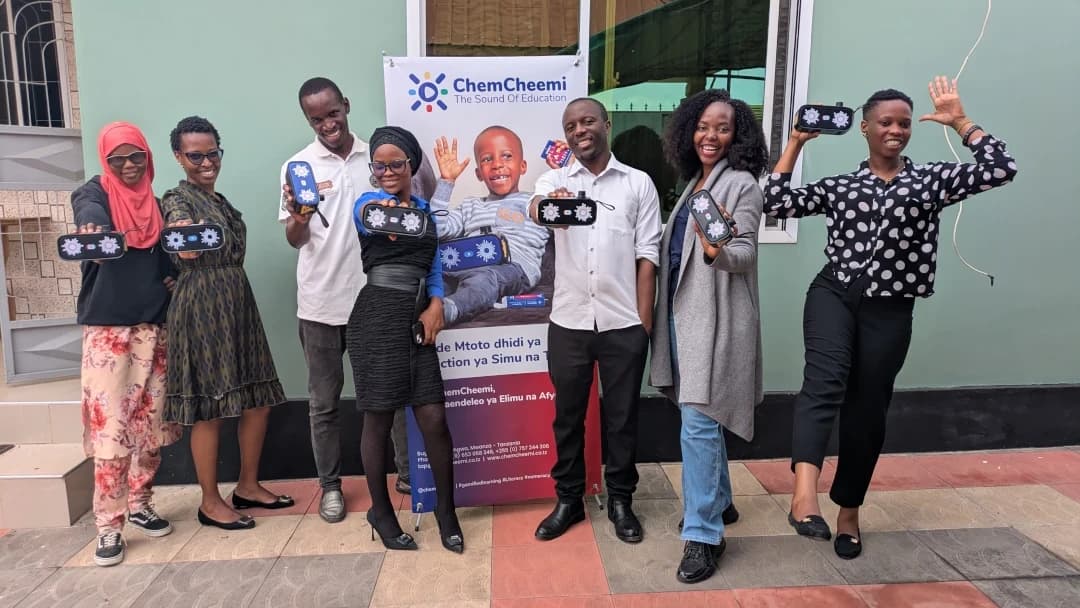
The Tanzania-based edtech company is building a solar-powered, offline-first learning system designed for learners operating in low-connectivity environments. Instead of relying on constant internet access, the platform delivers interactive, audio-based and tactile learning experiences that continue functioning even when infrastructure fails.
The model reflects a broader shift emerging across parts of Africa's education ecosystem — one where founders are beginning to design around infrastructure realities rather than around assumptions imported from more connected markets.
For ChemCheemi, that shift started with a simple question: why are digital learning tools still being designed as though electricity and internet access are guaranteed?
The company's answer is a low-cost device built to operate fully offline while supporting foundational literacy and numeracy in both Kiswahili and English. Lessons are delivered through gamified interaction, combining audio guidance with physical engagement to make learning accessible in environments where screens and connectivity are unreliable or unavailable.
The approach came directly from observing how teachers already operate in constrained systems.
"We saw classrooms running entirely on creativity and necessity," the team says. "Teachers were improvising every day to keep learning going. We wanted to build something that worked within that reality instead of adding another fragile system."
So far, ChemCheemi has reached more than 8,000 learners, with around 3,700 currently active on the platform. The system has been deployed in eleven primary schools across Mwanza, Shinyanga, Morogoro, and Geita.
In one case, a school reordered devices only three months after deployment — a significant signal in education systems where budgets are limited, and technology spending is heavily scrutinized.
The company has also continued expanding beyond school deployments. Through a conventional sales outreach approach focused directly on households, ChemCheemi recently acquired 65 new customers, including 64 parents and one additional school, contributing to 310 new learners reached within a single month.
That traction points to a challenge often overlooked in African edtech conversations: many families are actively seeking alternative learning support tools, but existing products remain inaccessible due to infrastructure requirements or pricing.
At the same time, the company is expanding its accessibility work through a Braille-enabled mathematics game developed in partnership with Buhongwa Special Needs Education Center in Mwanza.
The pilot reached eight visually impaired learners during its recent testing phase.
For ChemCheemi, the collaboration is not being treated as a side initiative or corporate social responsibility effort. It is part of a broader design philosophy that views accessibility as central to education innovation rather than secondary to it.
During one of the testing sessions, visually impaired students were able to independently engage with the tactile mathematics game after only minimal instruction.
The moment reinforced what many education advocates across the continent have increasingly argued: inclusive learning systems cannot be designed as afterthoughts.
Beyond the hardware itself, ChemCheemi has also introduced an AI-enabled dashboard that tracks learner engagement, participation patterns, and progress across activities. The system stores data locally and syncs to the cloud only when connectivity becomes available.
Learning continues offline regardless of internet access.
This type of hybrid architecture remains relatively uncommon across much of the global edtech sector, where cloud dependency is often treated as standard. But in infrastructure-constrained environments, offline-first systems may ultimately prove more scalable than connectivity-dependent models.
The policy implications are becoming harder to ignore.
Across Africa, governments and development institutions continue investing heavily in digital education strategies. Yet many initiatives still struggle with the same structural gaps: unreliable electricity, inconsistent internet coverage, device maintenance challenges, and limited localized content.
In practice, this has created a disconnect between policy ambitions and classroom realities.
ChemCheemi's model suggests a different approach — one where resilience, affordability, local language delivery, and offline usability are treated as foundational infrastructure rather than secondary product features.
It also reflects a broader evolution within African innovation ecosystems, where some founders are moving away from replicating Silicon Valley-style software models and toward building systems specifically adapted for local operating conditions.
For schools using ChemCheemi, the impact is practical rather than abstract.
Teachers can continue lessons during outages. Learners can access educational content without internet access. Visually impaired students can participate more independently. Parents can introduce digital learning support tools at home without relying on expensive connectivity.
In many ways, the company's strongest argument is not technological sophistication. It is reliability.
The system works where many others stop working.
And in education systems where interruption is often normalized, that reliability may be one of the most important forms of innovation.